Mon To Sat 10:00 AM to 7:00 PM

When we go to the office every day, we carry on a time-honored tradition of getting to know our clients.
Getting Dental Implants used to feel like a leap of faith. You would sit in the chair, the dentist would take some measurements, and you would simply trust that everything underneath your gums would line up the way it was supposed to.
Today, that guesswork is mostly gone. Digital dentistry has changed how implants are planned, placed, and finished, turning what used to be an estimate into a precise, mapped-out procedure.
In this article, we will walk you through exactly how this technology works, why it matters for your safety and comfort, and what to expect during a modern dental implant treatment.
A dental implant is a small titanium post that is placed into your jawbone to act as an artificial tooth root. Once it heals and fuses with the bone, a custom crown is attached on top, giving you a replacement tooth that looks, feels, and functions like a natural one.
Unlike dentures or bridges, implants do not rely on neighboring teeth for support, which makes them a long-term solution for missing teeth. The success of this treatment depends heavily on one thing: precise placement. This is exactly where digital technology has made the biggest difference.
For decades, dentists relied on flat, two-dimensional X-rays to plan implant surgery. The problem is that your jaw is not flat. It is a three-dimensional structure with nerves, sinuses, and varying bone density hidden beneath the surface.
A 2D X-ray simply cannot show depth or width accurately, which means a dentist working from one is essentially planning surgery with an incomplete picture. This is one of the biggest reasons older methods of dental implants sometimes led to complications that today’s technology can avoid.
Cone Beam Computed Tomography, or CBCT, changed this completely. A CBCT scan takes hundreds of images around your jaw in a single rotation and combines them into a detailed 3D model. This gives the dentist a complete, layered view of your bone structure from every angle, something a flat X-ray could never provide.
With a 3D scan, we can pinpoint the exact location of your nerves and sinus cavities before a single incision is made. A dental implant specialist can also measure bone density in different areas of the jaw to decide precisely where an implant will hold best. This step alone significantly lowers the risk of nerve damage or sinus complications during surgery.
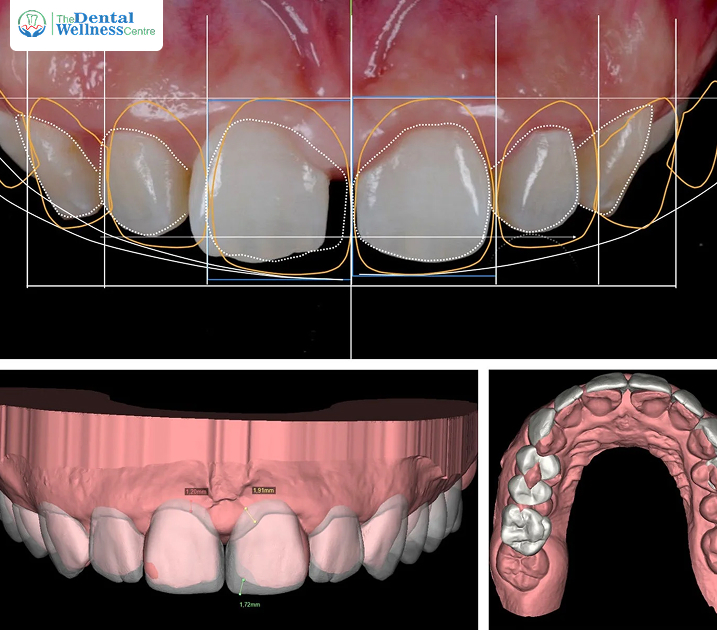
Once the scan is ready, the implant position is planned virtually using specialized software. The dentist places a digital model of the implant exactly where it needs to go, checking the angle, depth, and spacing on screen before touching the patient. In many ways, the surgery is already “done” once on a computer, long before it happens in real life.
See real smile changes from Dental Implants, Read blog on: Dental Implants Before and After: Real Transformations
A surgical guide is a custom-made template that fits directly over your teeth and gums. It has precisely positioned holes that tell the dentist exactly where to drill and at what angle, based entirely on the virtual plan created from your 3D scan.
Once the virtual plan is finalized, the guide design is sent to a 3D printer, which builds the physical guide layer by layer using biocompatible material. Because it is printed directly from the digital plan, the guide matches the plan with almost no margin for error.
Guided surgery often needs smaller incisions since the dentist already knows the exact path to follow. Smaller cuts generally mean less swelling and a quicker recovery for the patient.
Since the guide restricts drilling to a pre-planned depth and angle, the chances of drilling too close to a nerve or sinus are dramatically reduced compared to freehand placement.
When an implant is placed at the ideal angle and depth into the strongest available bone, it tends to integrate better and last longer, giving patients a more stable and durable result.
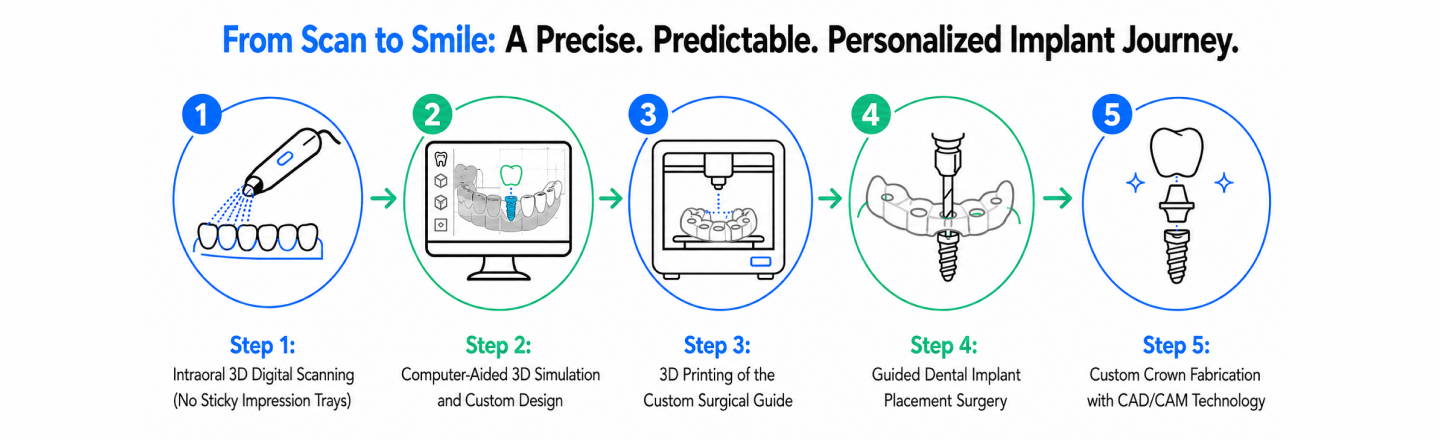
The journey usually begins with a digital scanner that captures a detailed 3D image of your teeth and gums in minutes, replacing the old messy putty trays entirely.
Your scans and CBCT data are combined in planning software, where the dental implant position, angle, and depth are simulated and finalized digitally.
The finalized digital plan is sent to a 3D printer to produce a guide that is unique to your mouth and your plan alone.
Using the printed guide, the implant is placed with the accuracy of the digital plan carried directly into the operating chair.
Once the implant has healed, a crown is designed and milled using CAD/CAM technology to match the shape, size, and shade of your natural teeth.
Why doctors suggest dental implant treatment for adults – Read full blog on: Dental Implants for Senior Citizens: A Complete Guide
Traditional implant methods rely on the dentist’s manual skill and 2D imaging, which leaves more room for small errors in angle or depth. Digital methods, by contrast, plan everything in advance and use printed guides for execution, resulting in more predictable outcomes, smaller incisions, and generally shorter recovery times.
Because digital planning accounts for bone density, nerve position, and the exact prosthetic outcome before surgery even starts, patients get implants that are placed for long-term function rather than just short-term convenience.
This is a major reason digital Dental Implants have become the preferred choice for patients seeking a dental implant treatment they can rely on for years.

At The Dental Wellness Centre, we bring this entire digital workflow together under one roof. With clinics in Ambawadi, Ahmedabad, and Gandhinagar, we have built our implant process around 3D imaging, guided surgery, and digital crown design, so every patient receives Dental Implants planned with precision rather than guesswork.
If you are searching for dental implants in Ahmedabad, our team is set up to walk you through this entire digital journey from your first scan to your final crown.
We believe that being the best implant dentist in Ahmedabad means more than just placing an implant. It means using the right technology to plan it correctly the first time.
Our approach combines detailed diagnostics, digital planning, and experienced clinical judgement, which is why patients often tell us we feel like the best dental clinic near me rather than just another option on a search results page.
The Dental Wellness Centre uses CBCT 3D imaging and intraoral scanning to plan every implant case digitally before surgery. This lets our dental implant specialist team identify nerves, sinuses, and bone density in advance and design a surgical guide that is unique to your mouth.
Our practice is led by Dr. Mable Patel, an Orthodontist & Implantologist (FICOI, USA). Our team focuses on making every step of your dental implant treatment as comfortable and transparent as possible, from your first consultation to your final follow-up visit.
Digital dentistry has taken much of the uncertainty out of implant surgery. With 3D imaging, virtual planning, and printed surgical guides, dentists can now plan Dental Implants with a level of accuracy that simply was not possible with older, manual methods.
If you are considering implants and want a team that uses this technology from start to finish, The Dental Wellness Centre is here to guide you through every step, backed by modern diagnostics and an experienced clinical team dedicated to giving you results that last.
Ans: It creates a detailed 3D map of your jaw, allowing dentists to plan exact implant position, angle, and depth before surgery, reducing errors and guesswork.
Ans: Digital implant treatment commonly uses CBCT scans, intraoral scanners, 3D imaging, CAD/CAM technology, and computer-guided surgical planning for greater treatment precision.
Ans: Yes, by improving placement accuracy and avoiding nerves or sinuses, digital dentistry lowers the risk of complications like nerve damage or implant failure.
Ans: Most patients needing implants are good candidates, though your dentist will confirm eligibility through a 3D scan assessing bone density and jaw structure.
Ans: A 3D CBCT scan provides detailed information about bone structure, nerves, and surrounding tissues, helping dentists plan implant position, depth, and angle accurately.

Dr. Mable Patel is an experienced Orthodontist and Implantologist at The Dental Wellness Centre in Ahmedabad, known for her gentle approach and excellence in smile design.

25 Sep 2026
Dr. Mable Patel
25 Aug 2026
Dr. Mable Patel

17 Aug 2026
 Dr. Vishal Patel